
| World Air Forces |
Argentina
Air Force
Unit History
Role: Commercial Transport.
The unit was formed on 23.10.1944, when
Líneas Aéreas del Sur Oeste (LASO) and Líneas Aéreas
Nor Este (LANE) merged. LASO was established on 4.9.1940 with two Junkers
Ju52 (164,165), while LANE was formed as
Línea Aérea Militar al Sur on 24.1.1940 and was
renamed on 20.9.1943 with Junkers Ju52, too.
Líneas Aéreas del Estado is the only Development Air
Transport State Organization. It depends on the Argentine Air Force and it was
created out of the desire and the need to undertake community activities that
would bring together the most densely populated areas with those remote areas of
territory which do not have fast and regular means of transport, thus creating
new routes which would later be used by private companies.
Thus, on July 1940, this Passenger, Cargo and Mail Transport Airline was set up,
covering the Palomar - Esquel route, with intermediate stopovers in Santa Rosa,
Neuquén and San Carlos de Bariloche. The maiden flight was made on 4.9.1940,
under the name of LASO (Líneas Aéreas del Sudoeste - Southwest Airlines). This
maiden scheduled official flight was made with a Junkers Ju52, under the command
of the former First Lieutenant Juan Francisco Fabri.
Later on, LANE (Líneas Aéreas
del Noreste – Northeast Airlines) was created, first as
Línea Aérea Militar al Sur on 24.1.1940 and
renamed on 20.9.1943 with Junkers Ju52, too.
LANE covered the Buenos Aires – Iguazú Waterfalls route. On 23.10.1944 the names
LASO and LANE were replaced by the single name of LADE (Líneas Aéreas del
Estado). The company continues to carry out the mission for which it was created
by counting on its branches scattered all over our Patagonia.
Despite the fact that LADE is dependent on the Argentine Air Force, it performs
a public service. And, in order to offer such service, LADE applies its
expertise in the areas of “air navigation”, maintenance, operating and managing
support of both its military and civilian staff, as well as its transport
airplanes. The routes covered by LADE and the special regional and promotional
sense, which guides all its action, noticeably improved the communication
possibilities. It also produced a very profound effect by breaking the
isolation, since the single possibility of having a means of transport capable
of linking the small towns with the big cities in few minutes creates a true
integration awareness among the settlers of the Patagonian region.
LADE makes it easier for the settlers to travel from the mountain border to the
coastline, by coordinating its flights and planes between the main centers and
the remotest destinations. Thus, it links small towns with centers of major
social, commercial and/or tourist importance, which are visited by international
tourists. With departures from Aeroparque and stopovers in Mar del Plata, San
Antonio Oeste and Puerto Madryn, going past Trelew, LADE links the most
important centers of the country.
Comodoro Rivadavia “Capital City of the Black Gold” is the most important
coastal Patagonian center. Patagonian towns like Rio Mayo, Alto Río Senguer,
José de San Martín, El Maitén, and El Bolsón, among others, are linked from
there. LADE, also, links Comodoro Rivadavia and Ushuaia, stopping over at the
coastal cities of Puerto Deseado, San Julián, Santa Cruz, Río Gallegos, and Río
Grande and the foothill cities of Perito Moreno, Gobernador Gregores, Río Turbio
and Calafate. During an important period of its existence and due to
international agreements, LADE kept a stopover on our Malvinas Islands, “Puerto
Argentino”. In 1972, the first flights with the Grumman Albatros were carried
out, later on Fokker F-27 and F-28 flights continued twice a week, and in 1982,
due to the South Atlantic conflict, LADE stopped providing air services.
Argentina is growing due to its irreversible southern expansion to which the Air
Force is constantly contributing. LADE air routes are an irrefutable proof of
it.
Líneas Aéreas del Estado (LADE)
| Base | Duration |
|---|---|
|
Base Aérea Militar El Palomar/ Buenos Aires |
1944 - 1965 |
| Aeroparque Jorge Newbery/Buenos Aires | 1965 - Present |
| Type | Qty | Service | Example Serials |
|---|---|---|---|
| Junkers Ju52 | 3 | 1941 - 1944 | 164-166 |
|
Douglas DC-3 |
1 | 1943 - 1944 | 169 |
| Dewoitine D.338 | 2 | 1943 - 1944 | 170,171 |
| Dewoitine D.333 | 2 | 1943 - 1944 | 172,173 |
| Junkers Ju52 | 5 | 1944 - 1950 |
T-164-T-168 |
|
Douglas DC-3 |
1 | 1944 - 1946 | T-169 |
| Dewoitine D.338 | 2 | 1944 - 1947 | T-170,T-171 |
| Dewoitine D.333 | 2 | 1944 - 1947 | T-172,T-173 |
|
Douglas DC-3 |
1 | 1946 - 1969 | T-16 |
| Douglas C-54A Skymaster | 3 | 1946 - 1970 | T-42,TC-44,T-45 |
| Douglas DC-4 | 4 | 1946 - 1966 | T-43,T-44,T-46,T-47 |
|
Douglas C-47A Skytrain |
1 | 1947 - 1959 | T-48 |
| Douglas C-54G Skymaster | 1 | 1961 - 1965 | TC-48 |
|
Douglas C-47A Skytrain |
9 | 1966 - 1970 | T-04,T-08-T-12,T-14,TC-19,TC-20 |
|
Douglas C-47-DL Skytrain |
1 | 1966 - 1966 | T-13 |
| Douglas DC-6 | 5 | 1966 - 1973 | T-51-T-53,TC-54,TC-55 |
| Fokker F-27 Friendship |
16 |
1968 - Present | T-41-T-45,TC-71-TC-79 |
| de Havilland Canada DHC-6 Twin Otter | 12 | 1968 - Present | T-81-T-90 |
| Fokker F-28 Fellowship | 5 | 1975 - Present | T-50,TC-51-55 |
| Lockheed L.100-30 Hercules | 1 | 1982 - 1999 | LV-APW |
| Boeing 707 | 5 | 1988 - 2004 | LV-ISA,LV-ISD,LV-LGO,LV-LGP,LV-WXL |
| Saab 340B | 4 | 2008 - Present | T-31-T-34 |
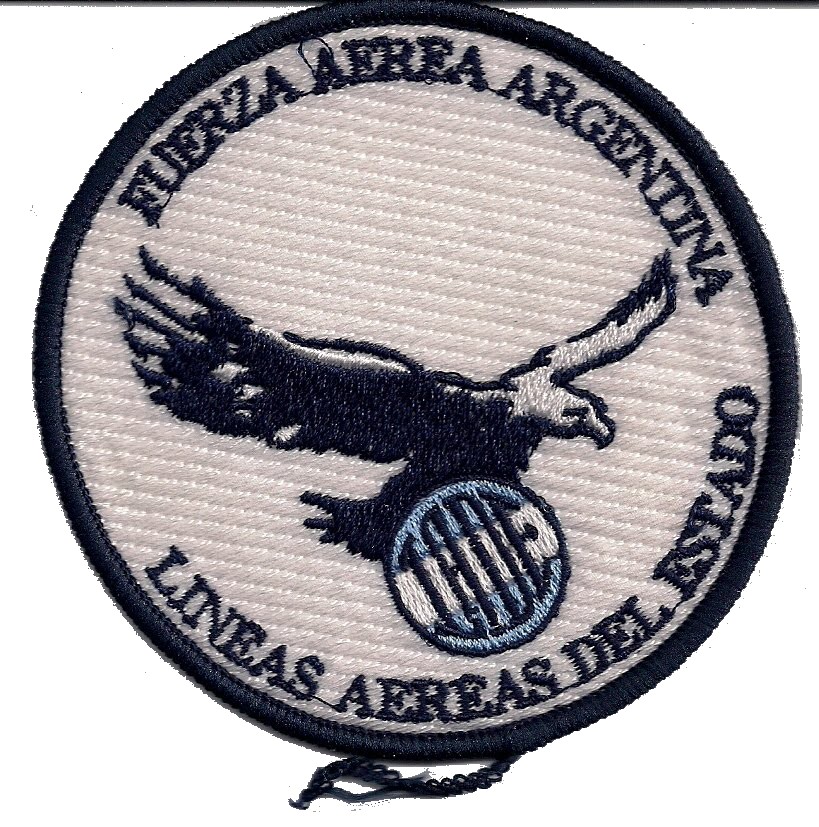
Unit Insignia:
|
Líneas Aéreas del Estado |
|
|
References:
- Líneas Aéreas del Estado (LADE) (official homepage)
- Linea Ala - Líneas Aéreas del Estado (LADE)
- World Air Forces Directory 2009/2010 (Ian Carroll)
| ^ Top of Page | << Last Page | Index Page | Next Page >> | Site Search |
| First Created: 3 February 2010 - Last Revised: 3 February 2010 | ||||
| Copyright © 2010 Erich Klaus. e-mail: erich.klaus@a1.net | ||||